Patients with Fitzpatrick IV to VI skin who walk into our Battersea clinic with a pigmentation concern tend to ask the same question first. Not about the in-clinic options. About what they should be using at home, between sessions and before they ever step into a clinic at all. The honest answer is that a careful at-home routine carries more of the load than most aesthetic websites admit, and a careless one is what makes pigmentation worse in the first place.
This article is our standing answer. It names three over-the-counter products we may consider at consultation, the morning-and-night routine we wrap them in, and the caveats that should sit on top of every word that follows. It is not a prescription. It is a clinical view, hedged and sourced, that should be read together with a full skin assessment by Arman Zaki, our founder and lead clinician.
What the evidence says, and what it does not
Two systematic reviews frame the entire at-home conversation. The first, Kashetsky et al. (2024), analysed 41 studies covering 877 patients with post-inflammatory hyperpigmentation. The headline finding is sobering. Across every treatment category, complete clearance rates were limited. Lasers and energy-based devices led at around 18 percent. Topical products, the category our three OTC recommendations belong to, sat at around 5 percent. Combination therapy delivered the strongest partial-response rates at around 85 percent. The authors' own conclusion described complete-response rates as "unsatisfactory" across all approaches.
The second review, Mar et al. (2024), focused specifically on hyperpigmentation in Skin of Colour. The most important sentence in it, for the purpose of this article, reads in full: chemical peels "should not be routinely recommended as a first-line treatment in this demographic but may have merit in refractory cases." Salicylic acid in particular was associated with a notable hyperpigmentation rate in the studied population.
What both reviews tell us, taken together, is that any product in the alpha hydroxy acid or beta hydroxy acid category, including the over-the-counter formulations we discuss below, needs to be considered carefully in Fitzpatrick IV to VI skin. Not contraindicated, not refused. Considered carefully, with guard rails, with sun protection, and ideally after a Fitzpatrick assessment at consultation.
What we see at consultation
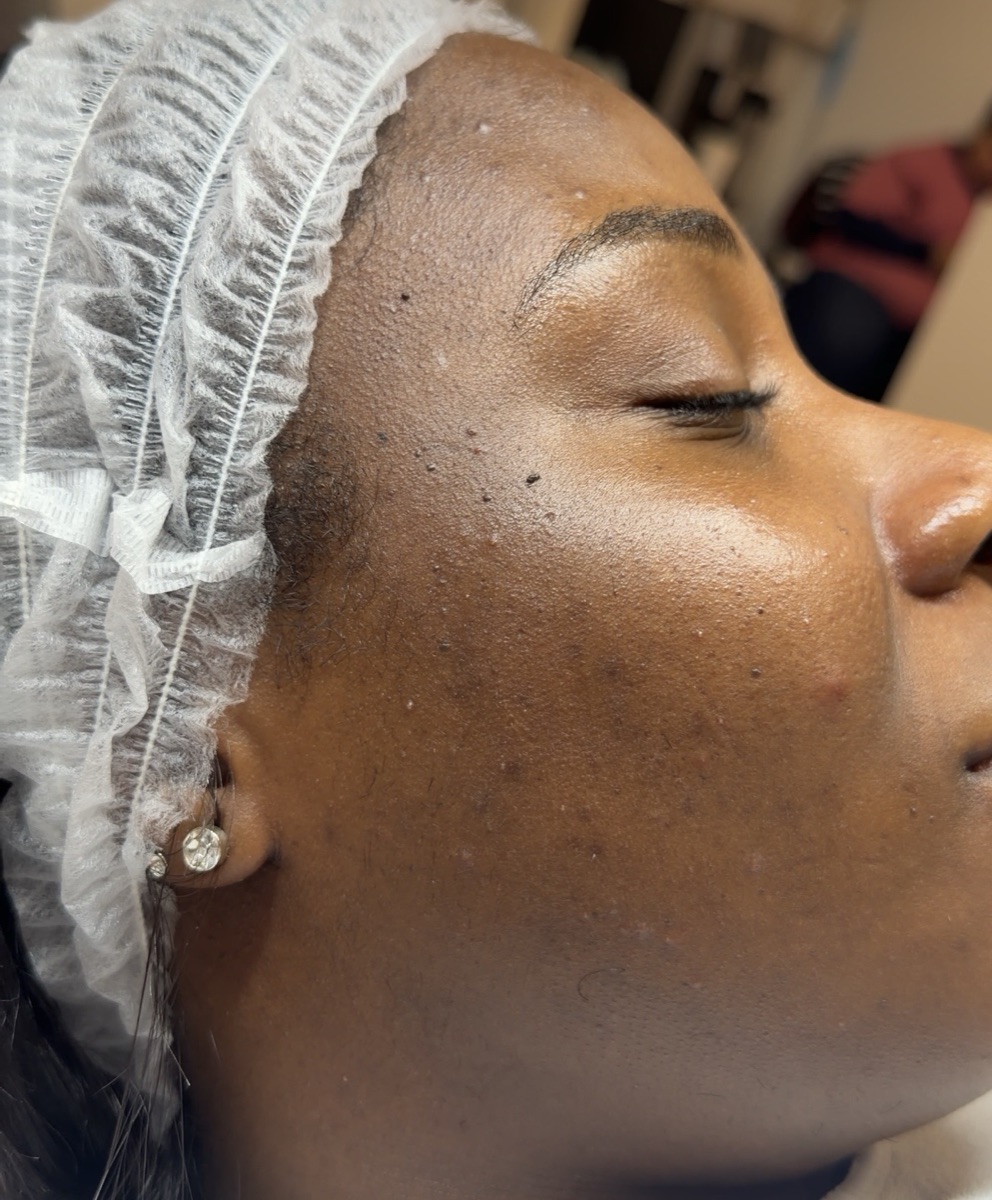
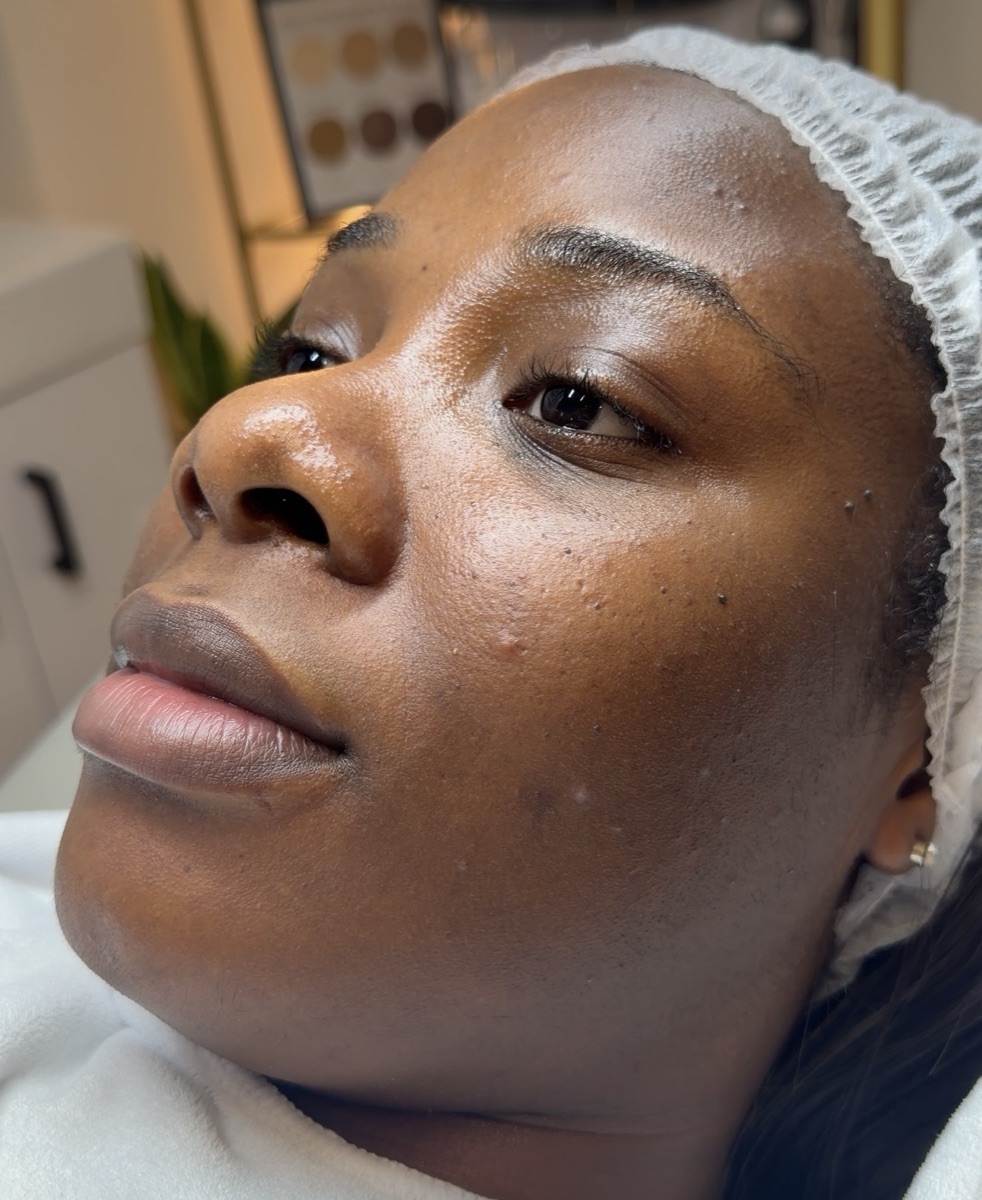
The kind of presentation this article is written for is shown below. Two close-up images from recent consultations at Melatone. These are real patients on the Battersea clinic bed, with documented consent for educational use. Both show the visual pattern that the at-home routine that follows is designed to support.
The full daily routine, first
Before the three named products, the routine that wraps them. This is the structure we ask patients to commit to for the first eight to twelve weeks. It is deliberately conservative.
Morning
- A gentle, non-foaming cleanser.
- A simple moisturiser appropriate for your skin type.
- Mineral SPF 50 on the face, the neck, and any other exposed pigmented area. Daily. Without exception. SPF is the single most important step in any pigmentation routine, more important than any active ingredient discussed below.
Night
- The same gentle cleanser.
- Two to three nights per week, an active ingredient (see Product 1 below).
- Alternate nights, a rich barrier moisturiser (see Product 2 below).
- Optional structured exfoliation step (see Product 3 below).
The three products, in order of how we think about them
The order matters. We list them in the order we think about them clinically, not in the order they will be applied at night.
Product 1, the active
The Ordinary Glycolic Acid 7% Toning Solution
An alpha hydroxy acid (AHA) toner at low concentration. We may consider this for patients with Fitzpatrick IV to VI looking to soften the appearance of post-inflammatory marks over time. Glycolic acid stimulates surface cell turnover, which can support the gradual fading of superficial hyperpigmentation.
How we suggest it is used. Two to three nights per week, evenings only, on freshly cleansed dry skin, followed by moisturiser. Never on broken or irritated skin. Never the morning before sun exposure. Mineral SPF 50 the following day is not optional.
When we would not recommend it. Active acne flare. The first 14 days after any in-clinic procedure. Pregnancy. Breastfeeding. Any history of allergic reaction to AHAs. Recent or planned laser within four weeks.
Realistic expectation. Visible softening of post-inflammatory marks may take six to twelve weeks of consistent, guard-railed use. Results may vary. Individual response depends on Fitzpatrick type, trigger management, and routine consistency.
Manufacturer's product page. We have no commercial relationship with The Ordinary.
Product 2, the barrier
Eucerin UreaRepair Plus 10% Urea Lotion
A urea-based humectant moisturiser. Of the three products in this article, this is the one we recommend with the fewest caveats. Urea has a strong evidence base as a humectant and barrier-supporting agent. For Fitzpatrick IV to VI patients with pigmentation that is concentrated in folds or on the body (neck, elbows, knees), the dry, slightly thickened-feeling skin around the affected area is often a driver of the appearance, not a separate concern.
How we suggest it is used. Alternate nights (on the nights you do not use the glycolic acid toner). A rich application to dry areas. Reapply after bathing if dryness persists.
When we would not recommend it. Open or weeping skin. Allergy to urea (rare but reported). On the face, only if patch tested and well tolerated, as the formulation is designed for body use.
Manufacturer's product page. We have no commercial relationship with Eucerin.
Product 3, the structured exfoliant
CeraVe SA Smoothing Cream
A salicylic acid (BHA) cream that includes ceramides and hyaluronic acid for barrier support. We may consider this for patients with rough or bumpy skin texture alongside the pigmentation concern. The salicylic acid in the over-the-counter CeraVe formulation is at a low concentration and is paired with barrier-supporting ingredients, which is structurally different from a clinic-strength salicylic acid peel.
An important caveat. Mar et al. (2024) highlighted salicylic acid as carrying a measurable hyperpigmentation risk in Skin of Colour at higher peel-strength concentrations. The over-the-counter cream is not a peel. We treat it as a structured exfoliant and use it with guard rails, not as a first-line product for active pigmentation.
How we suggest it is used. Once daily, morning or evening, on dry skin, followed by moisturiser. On the body for rough texture (back of arms, thighs). On the face only after a patch test and only with daily SPF.
When we would not recommend it. Active eczema or rosacea flare. Allergy to salicylates (including aspirin). Pregnancy. Broken skin. On the same nights as glycolic acid (rotate, do not stack).
Manufacturer's product page. We have no commercial relationship with CeraVe.
What this routine does not do
It is worth saying plainly. The three products above, used together as a routine, are a sensible foundation. They are not a substitute for an in-clinic assessment. They are not strong enough on their own to resolve moderate or severe post-inflammatory hyperpigmentation in Fitzpatrick IV to VI. They are not a fast fix. They are not safe in pregnancy. They are not appropriate during an active flare of acne, eczema, or any inflammatory skin condition.
They are also not skin-whitening products and they do not contain hydroquinone. Hydroquinone is a prescription-only medication in the UK and is not available over the counter for skin lightening. We do not include hydroquinone in any of our at-home recommendations.
Realistic timelines
Pigmentation in Fitzpatrick IV to VI does not lift in two weeks. The realistic expectation, with consistent use of the routine above, is noticeable brightening of post-inflammatory marks at around six to twelve weeks, with major improvement only after four to six months. Smoother texture typically arrives first. Tone evens gradually afterwards. Individual results vary.
For melasma, which is a chronic condition driven by hormonal and UV triggers (Ogbechie-Godec and Elbuluk, 2017), the expectation is management, not cure. The routine above forms the daily floor. In-clinic protocols (low-fluence 1064nm Nd:YAG laser per Wong et al. (2022), careful use of biostimulators, structured polynucleotide protocols) sit above that floor. They are decided at consultation.
The Melatone position on bleaching, restated
We get asked, every week, whether a patient should consider one of the topical lightening products available in unregulated channels online. The answer is no. Many of those products contain unlisted or higher-than-permitted concentrations of hydroquinone, mercury, or steroids, and the long-term harm they cause to Skin of Colour is real and documented. They are also, in many cases, not legal to import for personal use. We will not recommend them.
Our clinical position is simpler. Even tone is the goal. Lighter skin is not. Pigmentation in Fitzpatrick IV to VI is a phenotype to support and protect, not a problem to erase. The protocols we use at Melatone, in clinic and at home, are designed around that principle.
Frequently asked questions
Can I use glycolic acid on Fitzpatrick V or VI skin?
It depends on the formulation, the concentration, the frequency, and the rest of your routine. Low-concentration glycolic acid (around 7 percent) used at most two to three times per week, with daily mineral SPF, is the cautious starting point. Higher-concentration peels are a different conversation. Mar et al. (2024) state explicitly that chemical peels should not be routinely recommended as a first-line treatment for hyperpigmentation in this demographic. We discuss this at consultation before any home routine is set.
How long before I see results from an OTC routine?
Realistic expectation: noticeable brightening over six to twelve weeks, with major improvement only after four to six months of consistent use. Smoother texture typically arrives first, then gradual tone evening. Pigmentation in Fitzpatrick IV to VI is a chronic concern. Kashetsky et al. (2024) found that all current treatment modalities, including in-clinic ones, yield limited complete clearance, which is why we frame the goal as evening tone, not lightening. Individual results vary.
Do I need a prescription for any of these products?
No. The three products in this article are sold over the counter in UK pharmacies and online. We do not include hydroquinone in our at-home recommendations. Hydroquinone is a prescription-only medication in the UK and is not available over the counter for skin lightening. If a specific protocol calls for prescription support, that requires the appropriate prescriber pathway, via your GP or a prescribing dermatologist, not a home routine.
What if I am pregnant or breastfeeding?
Do not start this routine during pregnancy or while breastfeeding. Several of the topical agents in it, including alpha hydroxy acids and beta hydroxy acids, are not recommended during pregnancy or lactation. Use a gentle cleanser, a fragrance-free moisturiser, and daily mineral SPF only. Bring your consultation to us once you have finished breastfeeding.
When should I switch from at-home to in-clinic treatment?
When the at-home routine has had a fair trial, typically eight to twelve weeks of consistent use with mineral SPF, and you and your clinician feel the result is not enough. In-clinic options at Melatone include 1064nm Nd:YAG laser at low fluence (the evidence-anchored modality for Fitzpatrick IV to VI per Wong et al., 2022), polynucleotides delivered by Zaki, and curated HydroMED Pro protocols. Every escalation starts with a consultation and a Fitzpatrick assessment.
Does Melatone sell these products?
No. We recommend these over-the-counter products because they are accessible, affordable, and the formulations are predictable. We have no affiliate or commercial relationship with The Ordinary, Eucerin, or CeraVe. The recommendation reflects our clinical view at consultation. Your routine may be different after a full skin assessment with Zaki.
References (Harvard)
- Kashetsky, N. et al. (2024) 'Treatments for post-inflammatory hyperpigmentation: a systematic review', Journal of the European Academy of Dermatology and Venereology. doi: 10.1111/jdv.19566.
- Mar, K. et al. (2024) 'Hyperpigmentation treatments in skin of colour: a systematic review', Journal of Cutaneous Medicine and Surgery. doi: 10.1177/12034754241265716.
- Ogbechie-Godec, O.A. and Elbuluk, N. (2017) 'Melasma: an up-to-date comprehensive review', Dermatology and Therapy. doi: 10.1007/s13555-017-0194-1.
- Wong, C.S.M. et al. (2022) 'Low-fluence Q-switched Nd:YAG laser for the treatment of melasma: a systematic review', Medicina. doi: 10.3390/medicina58070936.