
Condition · Thinning edges and hair loss · Battersea SW11
Thinning edges and traction alopecia, an honest look.
You are not imagining it, and you are not to blame. If your edges have crept back, if you have started parting your hair to hide a thin patch, or if you have been told to just stop worrying about it, you deserve a proper look and a straight answer. Caught early, this kind of hair loss is often reversible. This page tells you the truth, including the parts we cannot promise.
A calm, unhurried consultation with Arman Zaki, GMC-registered Physician Associate (Ref A8131967). This is education first. We will not sell you a treatment your scalp does not need.
You are far from alone
One of the most common kinds of hair loss. And one of the most preventable.
A tight ponytail every day. A bun pulled up in a rush. Extensions or clip-ins that tug at the roots. The steady weight of long hair. These are ordinary, everyday things, and over time they can quietly thin the hair at the very front and sides. If you have noticed a widening parting, edges that are not what they were, or a hairline that seems to be creeping back, you are not imagining it, and you are not vain for minding.
The fear underneath is usually the same: that it won't grow back, and that no one will really take it seriously. We meet people who have been brushed off elsewhere, and who have spent a small fortune on oils and tonics that only ever sat on top of the problem. What you need first is not another product. It is someone to look properly, tell you plainly what is happening, and be honest about what can be turned around. Often, caught early, quite a lot can.
What is actually happening
What causes thinning edges and traction alopecia?
Traction alopecia is hair loss from repeated pulling on the roots. The everyday triggers are tight ponytails, top-knots and buns, sleek pulled-back styles, extensions and clip-ins, and the plain weight of long hair. Braids, cornrows, locs, weaves, wigs, and chemical relaxers add to the risk too. Anyone who wears their hair under tension day after day can develop it.
None of this means you did something wrong. Most of these styles are just how people like to wear their hair, and the damage builds slowly over years, usually without pain until the loss is visible. The point of naming the cause is not blame. It is that once you know tension is the driver, most of the power to stop it getting worse is in your hands. Very tightly curled hair does tend to be more fragile, so it can take less tension to do harm, but this is a problem for all hair types. Whether it is hair loss from a tight ponytail, a heavy bun, or extensions, the mechanism is the same steady pull on the root (Billero and Miteva, 2018; Haskin and Aguh, 2016).
The tell-tale sign
Is it traction alopecia? The "fringe sign."
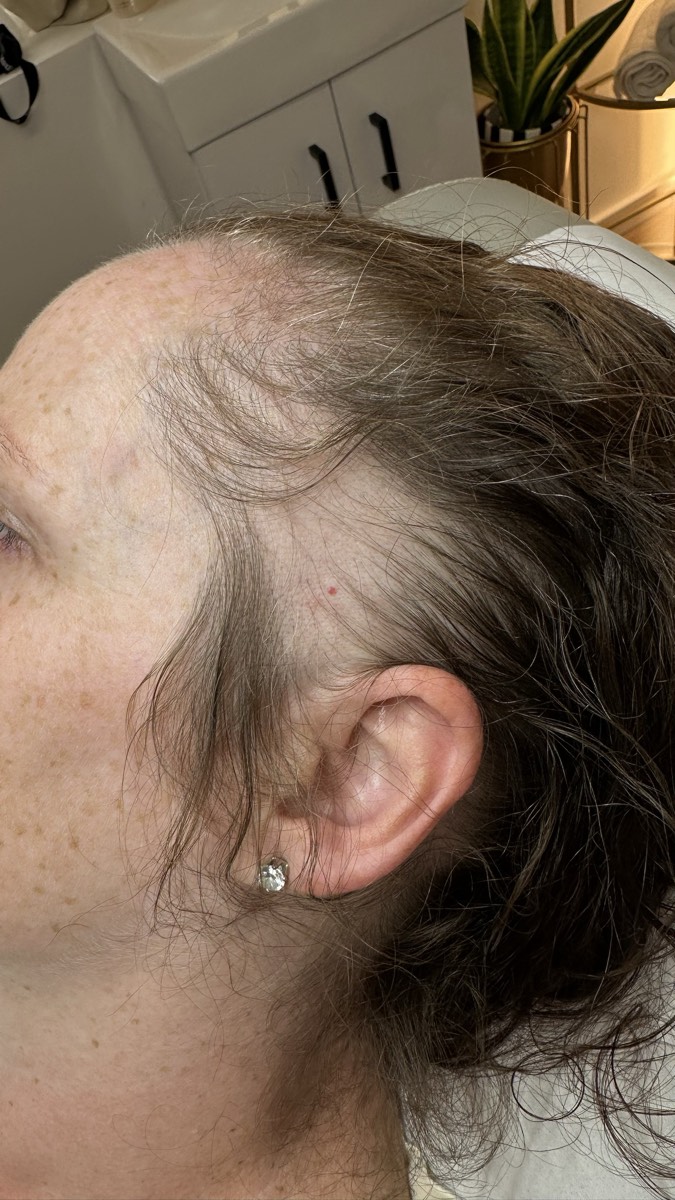
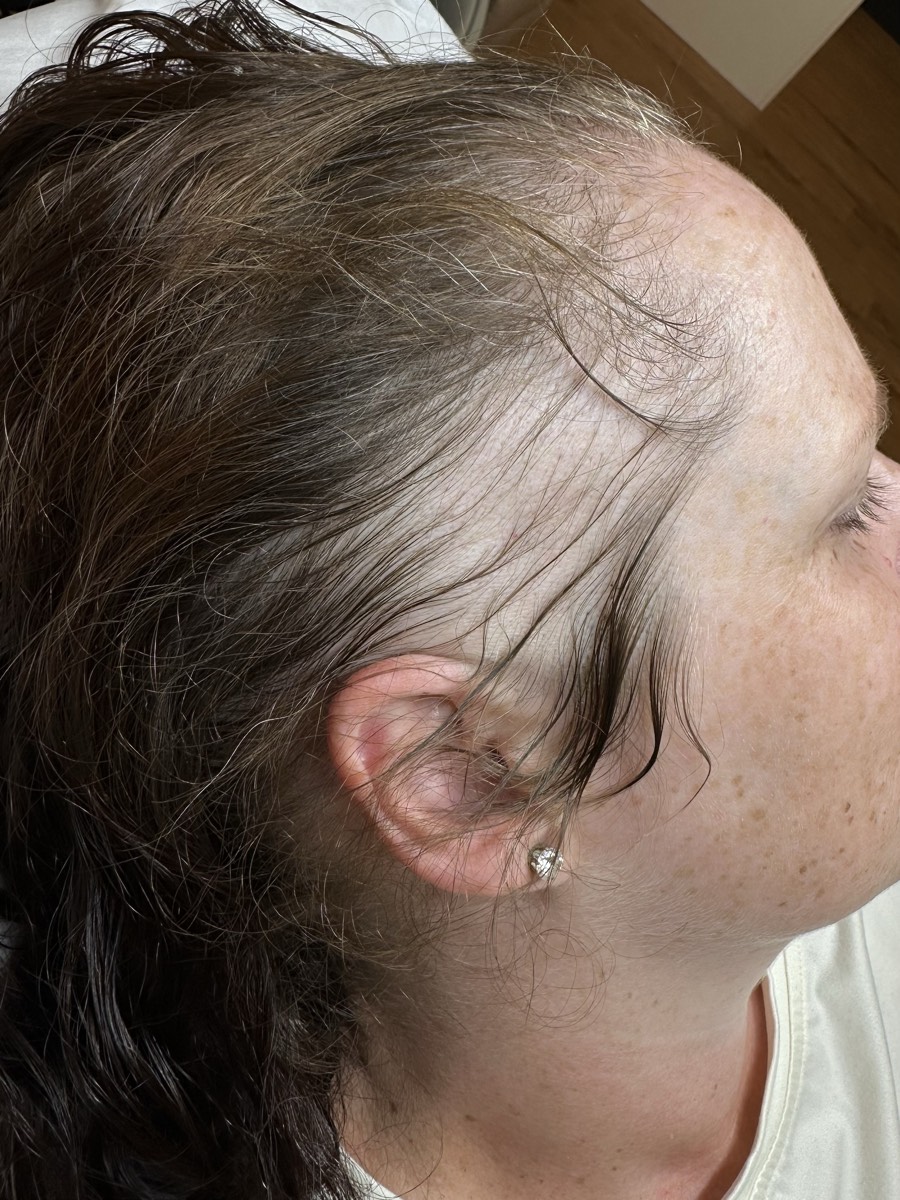
The clearest marker clinicians look for is the fringe sign: a thin line of hair that stays put right along the front and temple edges, while the hair just behind it thins or vanishes. Traction alopecia mostly hits the front and sides of the scalp. Early on you might notice itching, redness, flaking, small bumps or pustules, and short broken hairs before you notice the gaps.
If you look in the mirror and see that little kept row of hairs at the very edge with a barer band behind it, that pattern is meaningful, and it is worth having looked at rather than watched anxiously for another year. A receding hairline that still keeps its very front row of hairs is the classic picture of the fringe sign, and it points to traction rather than other kinds of hair loss. The early, itchy, bumpy stage is also the stage where changes make the most difference, which is exactly why it is a shame so many people wait (Samrao et al., 2011).
Getting the diagnosis right
Is it traction alopecia, CCCA, or something else? (why it matters)
It matters because central centrifugal cicatricial alopecia (CCCA) is a scarring hair loss that starts at the crown and is easily confused with traction alopecia. Telling the two apart usually needs a proper trichoscopy (dermoscopy) look, and sometimes a scalp biopsy to be sure. The right answer changes the whole plan, which is why a proper look matters first.
This is the part a rushed appointment gets wrong. Thinning at the edges points one way; hair loss spreading out from the crown points another, and that can need medical care sooner. We would rather send you to a GP or dermatologist for the right assessment than guess, because a wrong label wastes the months that matter most. We are also comfortable reading how traction alopecia presents, scars and heals across every skin tone, including richer and deeper skin where it is too often missed or dismissed (Sharquie et al., 2021).
What genuinely helps
How do I stop my edges thinning further?
The most useful answer, and the one with the strongest evidence, costs nothing: take the tension off. Loosen tight ponytails and buns, give your hair breaks from extensions and pulled-back styles, go easy on relaxers and heavy heat, and try not to carry long or heavy styles for hours on end. Changing how you wear your hair helps at any stage, and most of all when you start early.
We know that is easier said than done when a style is part of how you feel put together, so we work with you rather than lecturing. Small, practical swaps add up: a looser install, a wider parting, a fortnight of rest between protective styles, a gentler edge routine. If a style is sore going in or leaves your scalp tender, that soreness is a warning worth listening to (Billero and Miteva, 2018; DermNet, 2014).
The honest answer
Can traction alopecia grow back?
Honestly, there is no guarantee, and anyone who promises one is not being straight with you. Traction alopecia has two phases. Caught early it is non-scarring and often recovers once the pulling stops. Left under tension for years the follicles are destroyed and the loss becomes permanent and scarring. That is the whole reason early recognition matters so much. We will never promise you regrowth.
We say this gently, because we know the fear underneath the question is whether it is already too late. For a lot of people it is not, and the sooner the tension comes off, the more your scalp has to work with. But we will not dangle false hope to win a booking. So the honest answer to "will it grow back" is that it often can if it is caught early, and that it often will not grow back once the loss has scarred. If the follicles at your edges have already scarred over, we will tell you kindly and honestly, and we will still help you find the right next step (Sharquie et al., 2021; DermNet, 2014).
When to get medical help
When should I see a GP or dermatologist?
Sooner rather than later, especially if you can see the fringe sign, any scarring, redness or pustules, or thinning at the crown that might point to CCCA. Medical options a doctor might weigh up, such as topical or injected steroids, minoxidil, or clearing any infection, sit on limited evidence and are a prescriber's or dermatologist's call. They are not treatments we sell you.
If you have felt dismissed before, please do not let that stop you asking again. You are entitled to have your hair loss taken seriously. A good consultation should end with you knowing what you are dealing with and what the honest next step is, whether that is with your GP, a dermatologist, or simply changing how you wear your hair for a while and reviewing it (Billero and Miteva, 2018).
Where cosmetic support fits
Where cosmetic support like exosome therapy fits, and where it does not.
Cosmetic regenerative support, such as EXO-GROW exosome therapy delivered through microneedling, may only be worth considering where the follicle is still viable, meaning early and non-scarring. It is not a treatment for scarring alopecia or CCCA, and we will tell you so plainly and point you towards the right care when that is what you need. We make no regrowth or outcome claims.
We mention this last, on purpose, because the honest work comes first: reduce the tension, get the diagnosis right, involve a doctor when it is needed. Only where a living follicle can still be supported does something like EXO-GROW exosome scalp support even enter the conversation, and even then as cosmetic support for the look and condition of hair and scalp, never as a cure. If it is not right for you, we would rather lose the booking than sell you a false hope. Individual results vary.
How we help, honestly
Look properly. Say the truth. Point you the right way.
A consultation with us is a scalp and styling-history assessment and an honest conversation, not a hard sell. Here is what we will and will not do:
- We look properly at your hairline, including the fringe sign and the crown, and take your styling history seriously.
- We tell you plainly whether this looks like traction alopecia, something that needs a doctor's assessment, or a pattern we cannot be sure of without dermoscopy or a biopsy.
- We give you the practical, no-cost tension advice that has the strongest evidence behind it.
- Where a scarring alopecia or CCCA is possible, we refer you on to a GP or dermatologist rather than treating it ourselves.
- We only raise cosmetic support like EXO-GROW where the follicle is still viable, and we frame it as cosmetic support, not a cure.
What we will never do is promise regrowth, guarantee an outcome, or sell you a treatment your scalp does not need. That is the whole point of coming to a clinic that knows this hair.
The consultation
A proper look, and a straight answer.
One
Assessment
A close look at your hairline and crown, the fringe sign, any redness or bumps, and a full styling history: ponytails, buns, pulled-back styles, extensions, braids, weaves, wigs, relaxers, and how long you tend to keep each style in.
Two
An honest read
What this looks like, what it does not, and where we are not certain. Practical tension advice, and a clear steer on whether a GP or dermatologist should be involved.
Three
Next steps, no pressure
If cosmetic support is genuinely appropriate, we explain it honestly. If it is not, we say so. Either way you leave knowing what is happening and what to do next.
Questions, answered honestly
Before you book.
What causes thinning edges and traction alopecia?
Traction alopecia is hair loss from repeated pulling on the roots. The everyday triggers are tight ponytails, top-knots and buns, sleek pulled-back styles, extensions and clip-ins, and the plain weight of long hair. Braids, cornrows, locs, weaves, wigs, and chemical relaxers add to the risk too. Anyone who wears their hair under tension day after day can develop it, and very tightly curled hair tends to be more fragile.
Is it traction alopecia? The "fringe sign."
The clearest marker clinicians look for is the fringe sign: a thin line of hair that stays put right along the front and temple edges, while the hair just behind it thins or vanishes. Traction alopecia mostly hits the front and sides of the scalp. Early on you might notice itching, redness, flaking, small bumps or pustules, and short broken hairs.
Is it traction alopecia, CCCA, or something else? (why it matters)
Central centrifugal cicatricial alopecia (CCCA) is a scarring hair loss that starts at the crown and is easy to mistake for traction alopecia. Telling them apart usually needs a proper trichoscopy (dermoscopy) look, and sometimes a scalp biopsy to be sure. The right answer changes the whole plan, which is why a proper look matters before anyone touches your hair.
How do I stop my edges thinning further?
The strongest evidence points to reducing tension, and it costs nothing. Wear looser styles, take real breaks between braids, weaves, and extensions, step back from chemical relaxers and heavy heat, and avoid carrying long or heavy styles for long stretches. This helps at any stage, and most of all when you start early.
Can traction alopecia grow back?
There is no guarantee. Traction alopecia is biphasic. Caught early it is non-scarring and often recovers once the pulling stops. Left under tension for years the follicles are destroyed and the loss becomes permanent and scarring. Early recognition matters enormously, and we make no regrowth promises.
When should I see a GP or dermatologist?
Sooner rather than later, especially with the fringe sign, scarring, redness or pustules, or crown thinning that might suggest CCCA. Medical options a doctor might consider, such as topical or injected steroids, minoxidil, or treating an infection, sit on limited evidence and are a prescriber's or dermatologist's decision, not something we sell.
Where cosmetic support like exosome therapy fits, and where it does not.
Cosmetic regenerative support, such as EXO-GROW exosome therapy through microneedling, may only be worth considering where the follicle is still viable, meaning early and non-scarring. It is not a treatment for scarring alopecia or CCCA, and we say so plainly and refer you on where that is right. We make no regrowth claims. Individual results vary.
References
Where these facts come from
- Billero, V. and Miteva, M. (2018) 'Traction alopecia: the root of the problem', Clinical, Cosmetic and Investigational Dermatology, 11, pp. 149 to 159. Available at: https://doi.org/10.2147/CCID.S137296.
- DermNet (2014) Traction alopecia. Written by Kapadia, A., reviewed by Lyon, C. Available at: https://dermnetnz.org/topics/traction-alopecia (Accessed: 28 July 2026).
- Haskin, A. and Aguh, C. (2016) 'All hairstyles are not created equal: what the dermatologist needs to know about black hairstyling practices and the risk of traction alopecia (TA)', Journal of the American Academy of Dermatology, 75(3), pp. 606 to 611. Available at: https://doi.org/10.1016/j.jaad.2016.02.1162.
- Samrao, A., Price, V.H., Zedek, D. and Mirmirani, P. (2011) 'The "fringe sign": a useful clinical finding in traction alopecia of the marginal hair line', Dermatology Online Journal, 17(11), article 1. Available at: https://pubmed.ncbi.nlm.nih.gov/22136857/ (Accessed: 28 July 2026).
- Sharquie, K.E., Schwartz, R.A., Aljanabi, W.K. and Janniger, C.K. (2021) 'Traction alopecia: clinical and cultural patterns', Indian Journal of Dermatology, 66(4), p. 445. Available at: https://doi.org/10.4103/ijd.IJD_648_20.
An honest consultation
Book a proper look. Not a sales pitch.
The sooner tension comes off, the more your scalp has to work with. Come and have it looked at properly, with honest answers about what can and cannot be turned around.