At Melatone the standard course is 7 sessions, spaced 4 to 6 weeks apart. People often ask why 7, why not 5 or 6 or 10, and why the gap between sessions has to be that specific. The honest answer is that hair on your body is not all in the same place at the same time. It cycles through three phases, and laser is only effective in one of them. This article explains the cycle, what each session is actually doing, and how the published reduction figures line up with what we see in clinic.
1. The three phases of hair growth
Every follicle moves continuously through three biological phases. At any given moment, only one is the phase laser can act on.
Distribution at any given moment
Approximate distribution. Varies slightly by body region. Source: hair cycle biology, see citations.
A single session catches one cohort. The other 75 percent of follicles are biologically out of reach that day.
2. Why only the anagen phase responds to laser
The chromophore (target) for laser hair removal is melanin in the hair shaft. Only anagen follicles have one. The diagram shows what happens in each state.
Same laser, two follicle states
The laser is instant. What is slow is the biology of the cycle. Each session catches the cohort in anagen that day.
3. Why we space sessions 4 to 6 weeks apart
Treat too soon and you fire at the same cohort. Treat too late and the next cohort already re-entered telogen. The diagram shows the rhythm we are matching.
7 sessions across ~35 weeks, catching new cohorts as they enter anagen
Face and underarms tend to cycle faster (4 to 5 weeks). Legs and back tend to cycle slower (5 to 6 weeks). We book your interval off your specific area.
4. What 7 sessions buy you, area by area
Across 7 sessions over 7 to 10 months, most follicles pass through anagen at least once. Published reviews report 85 to 95 percent reduction in appropriately selected candidates.
Typical reduction after a complete course of 7
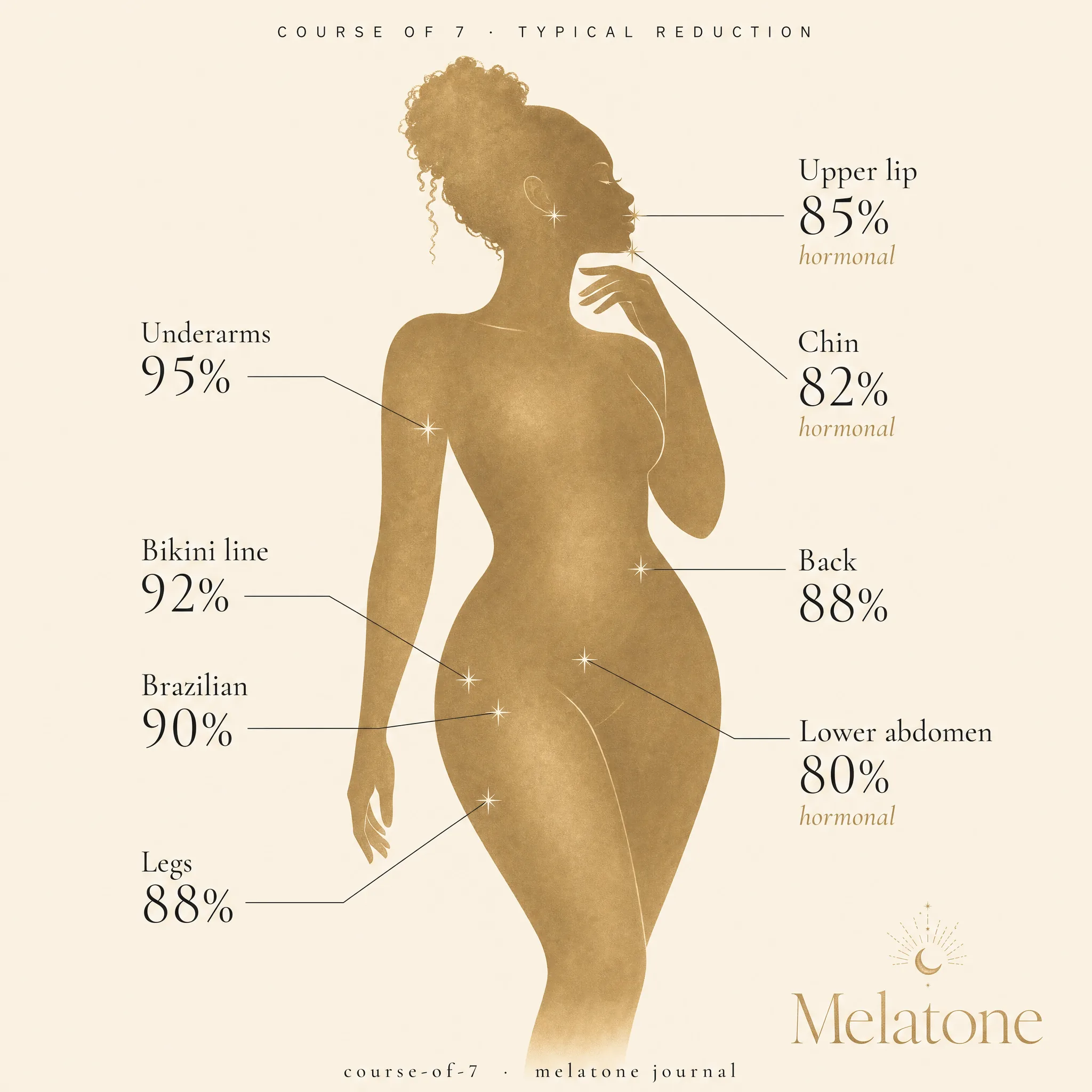
Averages from published reviews and clinical practice. Individual results vary by skin type, hair type, and hormonal factors. Lighter bars indicate hormonal areas, more likely to need maintenance.
85 to 95 percent reduction means the remaining hair is finer, lighter, slower-growing, and patchy. Not "no hair at all forever."
5. When 7 sessions are not enough, honestly
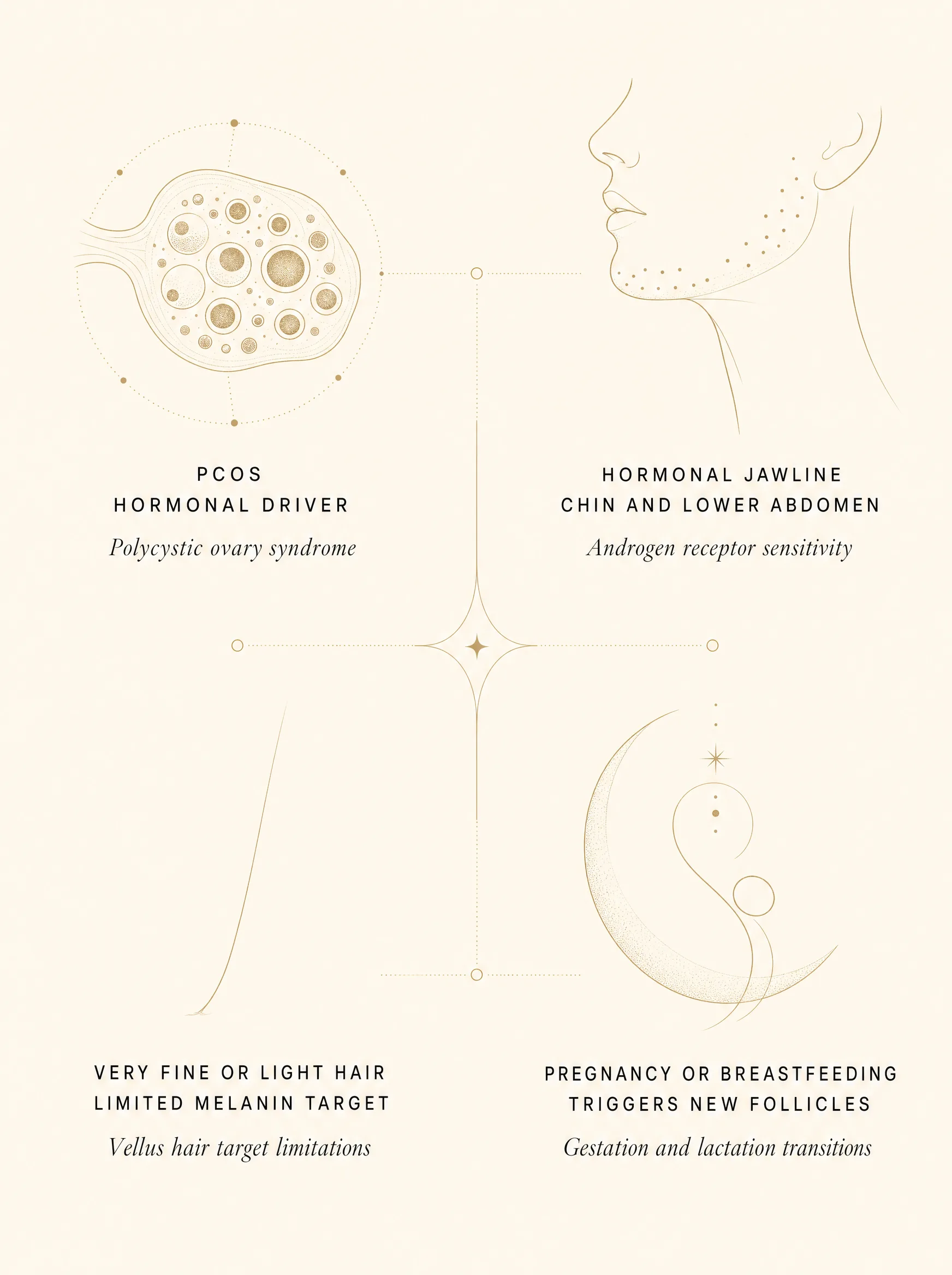
We say this at the patch test, not after you have paid. A few situations mean the standard 7 sessions are a strong start but not the complete picture. Four cases need a different plan.
PCOS
Hormonal driver
Polycystic ovary syndrome can produce new follicles after the original cohort is treated. Most patients still benefit from the course. Expect ongoing maintenance every 6 to 12 months.
Hormonal jawline
Chin and lower abdomen
Same logic. The course addresses the hair currently present. Hormonally driven new growth can appear later. Maintenance addresses it cleanly.
Very fine or light hair
Limited melanin target
Vellus, blonde, grey, or red hair holds little melanin. The laser has minimal target. Electrolysis is sometimes a better fit. We tell you at the patch test.
Pregnancy or breastfeeding
Triggers new follicles
Hormonal shifts during pregnancy and breastfeeding can push new follicles into anagen after the course completes. We pause the course in these windows.
Beyond 7 to 8 well-timed sessions, the dose-response curve flattens. More sessions back to back is not the right answer. Maintenance is.
6. The published evidence
The figures and clinical reasoning above are not Melatone's internal claims. They reflect a body of published clinical literature. We cite three.
Three studies on a champagne marble surface, Battersea clinic
Study 1 · 2022
Nd:YAG versus Alexandrite in Fitzpatrick IV to VI
Comparative axillary trial. Supports Nd:YAG as the safer choice for higher Fitzpatrick types with clinically meaningful reduction.
Moftah N, et al. (2022). J Dermatological Treatment.
Study 2 · 2026
Long-term outcomes systematic review
Systematic review reporting hair reduction reaching ~92 percent at 12 months in appropriately selected candidates.
Shurrab K, et al. (2026). Health Science Reports.
Foundational · 1999
The biology of hair follicles
Foundational review of anagen, catagen, and telogen phases. Cited in dermatological textbooks worldwide.
Paus R, Cotsarelis G. (1999). New England J of Medicine.
The studies were conducted on different populations and devices than ours. We share them as clinical context, not as efficacy claims specific to your treatment.
Course pricing exists because the clinical course makes sense. The clinical course does not exist because of the pricing.
What this means for your booking
If you are thinking about laser hair removal at Melatone, here is the practical version of everything above:
- Start with a £10 patch test. We will assess your Fitzpatrick type, your hair characteristics, any hormonal factors, and any contraindications. The £10 is deducted from your course cost if you book.
- Expect 7 sessions across roughly 7 to 10 months. We will set the interval for your area and your skin response, typically 4 to 6 weeks.
- Each session lasts 15 to 45 minutes depending on the area. We use 1064nm Nd:YAG for Fitzpatrick V and VI, with the wavelength chosen at your patch test for everyone else.
- Single sessions are available on Treatwell if you want to try the experience before committing to a course. We will tell you clearly that singles will not produce the full reduction outcome that the course can, and why.
Important information
Laser hair removal is a medical aesthetic procedure. The 85 to 95 percent reduction range cited in this article is what published reviews report for appropriately selected candidates. Individual outcomes vary by skin type, hair type, hormonal status, and the area treated. The outcomes described are not guaranteed for every patient.
A patch test and Fitzpatrick skin assessment is required before your first session. Melatone reserves the right to decline or modify treatment when assessment indicates it would not be appropriate. Laser hair removal is not performed during pregnancy or breastfeeding, on tanned or recently sun-exposed skin, or with certain medications. Full contraindications are reviewed at your patch test.
Clinical citations on this page are provided for informational context. Study populations and devices may differ from those used at Melatone. Citations do not constitute claims about outcomes at this clinic.
Course pricing exists because the clinical course makes sense. The clinical course does not exist because of the pricing.
Start the course properly
Book a £10 patch test, or message us first.
If you would like to ask anything specific about your hair type, your Fitzpatrick type, or whether 7 sessions is the right starting point for your situation, WhatsApp us. Otherwise book the £10 patch test on Treatwell, deducted from your course cost when you proceed.
About the author

Catia Zaki
Clinic Manager, Hydrofacial & Laser Lead · VTCT Level 4 certified in Laser and IPL
Catia delivers all laser hair removal at Melatone Skin Clinic in Battersea, plus HydroMED Pro facials and skin assessments. Every laser appointment begins with her Fitzpatrick assessment. Clinically reviewed by Arman Zaki, GMC-registered Physician Associate.
Frequently asked
Why are 7 sessions recommended for laser hair removal?
Hair grows in three phases: anagen (active growth), catagen (transition), and telogen (resting). Laser only damages the follicle during anagen, when melanin is present in the growing hair shaft. At any moment, only about 20 to 30 percent of follicles in a body region are in anagen. Sessions spaced 4 to 6 weeks apart catch each new cohort entering anagen. Across 7 sessions, most follicles in the region pass through anagen at least once, producing approximately 85 to 95 percent reduction in appropriately selected candidates.
Why are sessions spaced 4 to 6 weeks apart?
Most body-region follicles complete a cycle from telogen back into anagen within 4 to 6 weeks. Treating too soon means the same cohort already addressed last visit, with no new follicles to target. Treating too late means previously dormant follicles re-enter telogen before they can be caught. The window varies slightly by area, which is why we book your interval based on your specific area and skin response.
What if 7 sessions are not enough for my hair?
For most body and face areas, 7 sessions reach the 85 to 95 percent reduction range. Hormonally driven hair (chin, jawline, lower abdomen) can require maintenance every 6 to 12 months thereafter. Conditions such as PCOS can also extend the course. We discuss realistic expectations at the patch test, not after you have already paid for a course.
Can I book fewer than 7 sessions?
Single sessions are bookable on Treatwell. For most patients, fewer than 7 sessions across a body region produces partial reduction that returns within months as previously untreated follicles re-enter the cycle. The course of 7 is a clinical recommendation grounded in the hair cycle, not a sales bundle. We explain this fully at the patch test so you can decide what makes sense for you.
Does the same logic apply to Fitzpatrick V and VI skin?
Yes. The hair growth cycle operates the same way regardless of Fitzpatrick type. What changes for darker skin is the wavelength. At Melatone we lead with 1064nm Nd:YAG for Fitzpatrick V and VI, the established standard for safer treatment of deeper skin tones. The session cadence and the 7-session course apply across all skin tones.