A patch test is the short appointment that decides whether your laser course is set up correctly or guessed at.
It is also the part most often explained badly. Most clinic pages tell you the test exists, that it is quick, and that you should watch for redness. That last instruction is the problem. On brown and black skin, redness is often not what you will see.
So this page says what the test is, why it is not optional in the UK, and what is and is not normal afterwards, written separately for light skin and for deeper skin tones.
The 30 second version
- A patch test is required before any laser course. UK guidance words it as an obligation, not a suggestion. Yours is £10, takes about 30 minutes depending on your concerns and questions, and comes off your course cost.
- Your first full session is 48 hours later, or longer if your skin is still reacting.
- Normal, on light skin: a pink flush and small raised bumps around individual hairs, settling over a few hours.
- Normal, on brown and black skin: usually no red at all. The area looks slightly deeper or duskier, and you feel the bumps more easily than you see them.
- Call us on 020 3576 7373 if you get blistering, scabbing, swelling that keeps growing, pain that is worsening, or the test spot changing colour over the following days.
 Pay for your course in full on the day in clinic. If you have Klarna, you can use it on our card terminal. How paying with Klarna worksKlarna is credit. 18+, UK residents only, subject to status. Missed payments may affect your credit score.
1. What a patch test actually is
A patch test, also called a test patch or a test spot, is a small controlled trial of the laser on the area we plan to treat. It is not an allergy test and it is not the same thing as the patch test a hairdresser does before colouring your hair, which checks for an allergic reaction to dye. A laser patch test checks how your skin absorbs and disperses laser energy, so that your settings are chosen from what your skin does rather than from an assumption about your skin tone.
The British Medical Laser Association, whose treatment guidelines are the reference document UK laser clinics and their insurers work to, specifies what a compliant test involves:
- Your Fitzpatrick skin type is assessed first. The Fitzpatrick scale is the standard way clinicians describe skin tone and how it responds to light, running from I, very fair skin that burns easily, to VI, deeply pigmented brown or black skin. BMLA states that skin typing "should be performed using the Fitzpatrick Scale to facilitate appropriate choice of treatment parameters". Yours decides your settings.
- The test goes on "the least conspicuous part of the area being treated", so that if the skin reacts, it reacts somewhere you can cover.
- It is a handful of shots, not a session. BMLA: "typically will comprise of 2 to 6 individual LASER or IPL shots".
- Every area gets its own. BMLA: "Each body area requiring treatment must have a separate test patch performed." Underarms and a chin are different skin, different hair and different risk.
A patch test is not a formality before the real appointment. It is the measurement the real appointment is built on.
2. Why it is not optional in the UK
Three separate systems point the same way, and none of them treats the patch test as a courtesy.
The professional body says must, not should
The BMLA treatment guidelines state plainly: "Patients must be given a skin patch test prior to treatment." The sentence uses an obligation, not a recommendation. It is worth being precise about what kind of evidence that is: this is professional consensus and standard of practice, not the result of a randomised trial. No published trial has compared laser courses with and without a preceding patch test, and any clinic claiming otherwise is overstating what exists.
The insurance market treats omission as a failure of care
Hamilton Fraser, one of the largest UK aesthetics insurers, processed "over 1,096 aesthetic malpractice claims" between January 2020 and November 2024, of which 210 were linked to laser treatments. That was the second largest category, behind dermal fillers at 245. Two cautions on that figure: it is the insurer's own claims count with no denominator, so it cannot be turned into a complication rate, and it says nothing about how many of those claims involved a missing patch test. What the insurer does say is procedural, and it is a re-test rule rather than a first-test rule: "Perform a new patch test when a different area is being treated or when the device has been serviced." The same insurer directs practitioners to the BMLA guidelines rather than issuing its own clinical protocol.
Laser is a licensed activity where we are
Melatone™ is in the London Borough of Wandsworth. Laser and intense pulsed light treatments there require a Special Treatment Establishment Licence under the London Local Authorities Act 1991, alongside tattooing, micropigmentation and electrolysis. The licence requires that "all persons providing special treatments are suitably qualified and/or trained to carry out those treatments", with those records held on the premises. To be accurate about what that licence does and does not do: the borough's public licence page sets out premises licensing and practitioner qualification, and does not itself mandate a patch test. The patch-test obligation comes from BMLA, from device manufacturers' instructions for use, and from insurers, not from the licence.
The honest version
A patch test cannot rule out every reaction. Skin can respond differently over a larger area, on a different day, or after a change in medication, sun exposure or health. It reduces the chance of a bad first session and it sets your parameters. It is not a guarantee, and any clinic that describes it as one is making a claim UK advertising rules do not allow.
3. How long before your first full session
BMLA sets the standard: "Normally, the patient must wait a minimum of 24 to 72 hrs after skin test patches depending on manufacturer's or EMP / ERHP guidance." The follow-on sentence is the one that matters: "Treatment may only proceed fully if no adverse skin reactions are observed." The interval is not a waiting period for its own sake. It is the window in which a reaction has time to declare itself.
UK practice varies more widely than most clinic pages admit, so here is the honest spread:
- 24 to 72 hours is the BMLA minimum, with the exact figure taken from the laser manufacturer's instructions for use.
- Around six weeks is used by at least one NHS service. Leeds Teaching Hospitals tells patients: "We will assess your response at your first treatment appointment (approximately six weeks following your test area)."
- 3 to 7 days is the common private-clinic convention in the UK. It is convention, not trial evidence, and no source we could find offers a published rationale for the specific number.
- 48 hours is the Melatone standard, inside the BMLA window and at the longer end of it.
At Melatone the standard is 48 hours. That sits inside the BMLA window and gives a reaction two full days to declare itself, which matters because BMLA puts blistering anywhere from a few hours to several days out and scabbing or scaling at 12 to 24 hours. Your first full session is booked no sooner than 48 hours after your patch test.
We will extend it when your skin tells us to. If the test area is still reacting at 48 hours, if you are Fitzpatrick IV to VI and the spot is still deeper in shade than the skin around it, or if anything on your list in section 6 has appeared, we wait and reassess rather than treat to schedule. That decision is clinical, not commercial.
4. A normal reaction on Fitzpatrick I to III skin
On lighter skin, the expected picture is well described and colour-led. BMLA lists the satisfactory treatment end points as "moderate erythema / redness of the skin", "moderate peri-follicular oedema that is patchy and not confluent (merged together)" and "mild puffiness to the treatment area", alongside carbonising of the hair stubble.
Leeds Teaching Hospitals NHS Trust describes the same thing in patient language: "Immediately after treatment, the skin usually looks pink and there is usually some swelling (like nettle rash) which lasts for a few hours." The leaflet adds that "some patchy pinkness may also be present for 7 to 10 days or occasionally, longer".
So on Fitzpatrick I to III, over the first 24 to 72 hours you would expect:
- Pink or red skin at the test spot, strongest in the first few hours, fading down over the first day.
- Small raised bumps around individual hair follicles, patchy rather than merged, like a localised nettle rash. This settles within hours.
- Mild warmth and a mild sunburn-like sensation.
- Sometimes, faint patchy pinkness lingering for up to 7 to 10 days.
The failure mode to watch for on lighter skin is intensity, not detection: the reaction is visible, and the question is whether it goes too far. BMLA's stop signs during treatment include erythema in the shape of the beam or applicator head, generalised confluent erythema where the redness merges into a single sheet, and perifollicular swelling that merges together rather than staying patchy.
5. A normal reaction on Fitzpatrick IV to VI skin
Here the standard description stops working, and almost no clinic page in the UK says so.
Erythema, the redness that every "what to expect" page tells you to look for, is masked in deeply pigmented skin. The Pharmaceutical Journal puts it directly: "Presentations such as erythema, which is easily visible in lighter skin tones, is masked in SOC owing to skin being naturally darker." The same review notes that inflammatory lesions "can appear more pink, violaceous, grey or even dark brown in colour". A 2025 review in Cureus reaches the same conclusion for inflammation generally: "In cases of obscured inflammation, with deepening skin tones, the color to look for may not be what is typically expected with erythema but instead may present as rather violaceous, gray, or brown hues."
BMLA itself acknowledges this, in a line that gets very little attention. Among the reactions that require treatment to be aborted immediately, the first listed is "skin colour changing to a whitish, grey or darker shade". Not redder. Darker. The national guidance already accepts that the danger sign in pigmented skin is a change in shade, not a flush of red.
The same reaction, 48 hours after the same settings
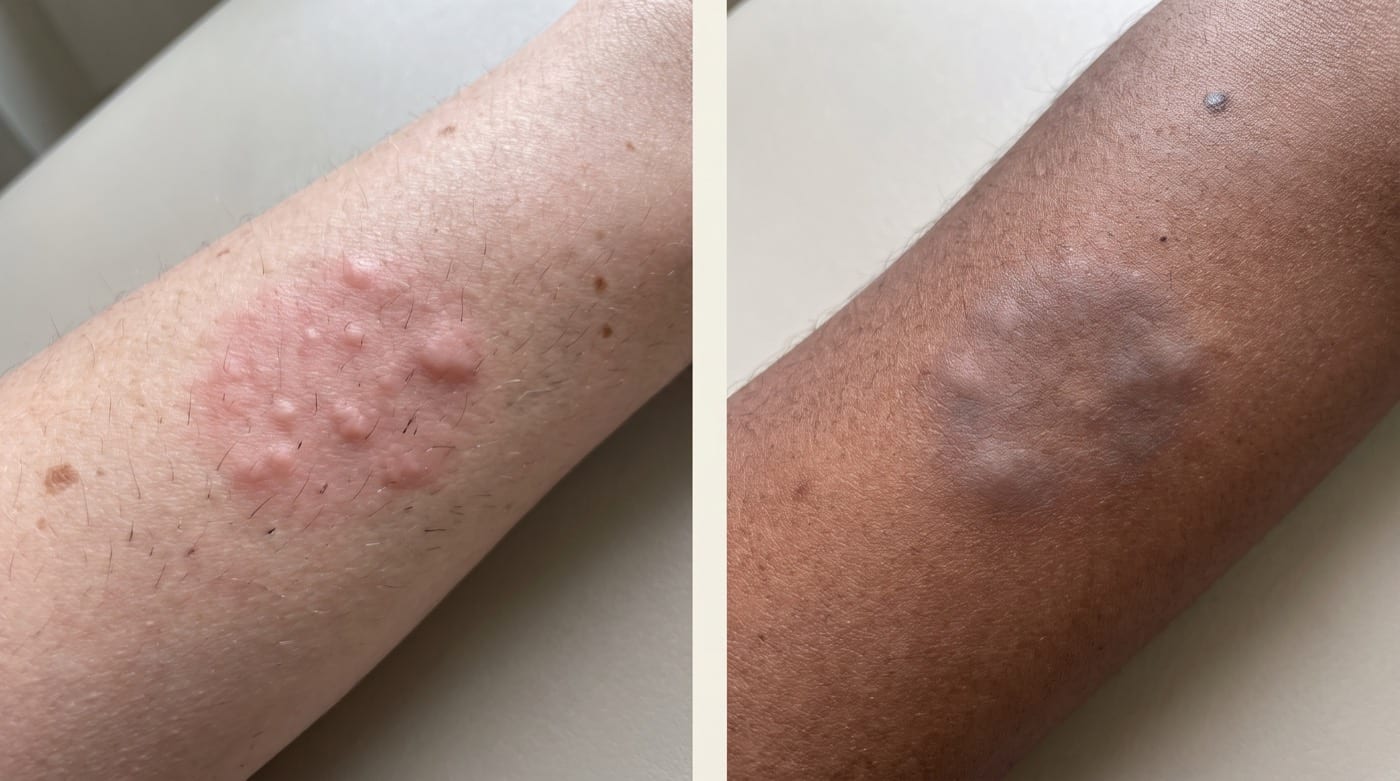
Fitzpatrick II, 48 hours
Fitzpatrick V to VI, 48 hours
Left, the flush is the first thing you notice. Right, there is no red to find. The same swellings are there and are read by touch and by the way light catches them. Both of these are normal reactions at 48 hours.
Generated illustration, not a photograph of a patient. Rendered for this page because no freely licensed clinical photograph of this comparison exists.
So on Fitzpatrick IV to VI, over the first 24 to 72 hours, read your test spot on four channels, not one:
- Colour, widened. Rather than pink or red, expect the area to look deeper, duskier, slightly violaceous or greyish against the surrounding skin. That is the equivalent of the pinkness described above, not a separate problem.
- Texture and swelling. The small bumps around each follicle are usually easier to feel than to see. Run a fingertip over the spot and compare it to untreated skin nearby. Patchy, separate bumps that settle over hours are the expected finding. Cureus explicitly recommends this substitution where redness is unreliable: "Visual erythema underrepresented; palpation and texture assessment recommended."
- Warmth and tenderness. Mild warmth for a few hours is expected. Heat that is still building the next day is not.
- What happens after day three. This is the channel that matters most on darker skin. BMLA notes that hyperpigmentation and hypopigmentation "may be observed several days to weeks after treatment if the skin has an adverse reaction". A test spot that looks fine at 48 hours and then darkens over the following fortnight is telling you something, and we need to see it before your first full session.
Practical instruction
Photograph your test spot in natural daylight, from the same angle, on day one and again on day seven. On Fitzpatrick IV to VI skin, a same-light comparison detects a shade change that the eye will miss day to day. Bring both photos to your first session, or send them to us on WhatsApp. This is the single most useful thing a patient with brown or black skin can do between the two appointments.
See it, on DermNet
We do not reproduce clinical photographs here. DermNet, the dermatology image reference used by clinicians worldwide, licenses its watermarked images for non-commercial use only under Creative Commons Attribution-NonCommercial-NoDerivatives 4.0, and this is a clinic page. So rather than repackage their work, we send you to it. Each link opens their own photo library, including images across a range of skin tones.
- Post-inflammatory hyperpigmentation, the darkening that can follow an adverse reaction, days to weeks later
- Skin phototype, the Fitzpatrick scale we assess you against, and its limits
- Folliculitis, the inflamed follicles that can follow hair removal and are sometimes mistaken for a burn
- Pseudofolliculitis barbae, razor bumps, the condition laser often treats in coarse and afro hair
- Lasers in dermatology, their overview of laser adverse effects
Images and content on those pages are copyright DermNet, used here by reference only. See the DermNet image licence. Photographs of a reaction are a guide, never a diagnosis. If your test area concerns you, call us rather than compare it to a picture.
6. What is not normal, and when to call us
Call us on 020 3576 7373 if you see any of these. Or message us on WhatsApp. This list applies to every skin tone.
Each timing below comes from BMLA's own list of adverse reactions.
- In the first few hours. Redness or darkening that is getting worse, not fading. Swelling that keeps growing. Itching that will not settle.
- A blister, at any point. This is a small raised pocket of fluid. It can start as a lump or a hive. It is more likely if your skin was tanned. Sometimes it appears several hours later.
- Scabbing or flaking, 12 to 24 hours after.
- Sore, itchy, puffy skin, 2 to 4 days after. This timing can mean infection.
- The test spot changing colour, days to weeks after. Darker than the skin around it, or lighter. Tell us even if it does not hurt.
You do not need to work out which one it is. If something worries you, call. That is what the number is for.
If the colour does change
Darkening usually fades. StatPearls puts it at "within 3 to 4 months" after laser.
Lightening is less common but more stubborn. Its "onset can be delayed", it is harder to treat, and it is "less likely to resolve spontaneously".
On brown and black skin the darkening can take longer. The Pharmaceutical Journal gives 6 to 12 months when it sits in the upper layer of skin, and years when it sits deeper. DermNet is blunter about laser specifically: "Extreme caution is needed when treating darker-skinned individuals as a permanent loss, or variable pigmentation may occur longterm."
This is why we want to see a colour change early, and why we would rather delay your first session than push on.
What about scarring
Scarring is rare. BMLA describes it as the end of a chain: a bad reaction, then blistering or heavy scaling, then infection and scabbing.
Every item on the list above is a point where that chain can be broken. That is the whole reason for the list.
A number we will not quote at you
You will find "26 to 36 percent risk of post-inflammatory hyperpigmentation" repeated on aesthetics pages about darker skin. That figure is real, but it is for laser resurfacing, which is an ablative procedure, not laser hair removal. There is no equivalent published incidence rate for post-inflammatory hyperpigmentation after laser hair removal in Fitzpatrick V and VI skin. We would rather tell you that the number does not exist than borrow one from a different procedure.
7. Why this matters more on brown and black skin
Two independent problems stack on top of each other, and the patch test is where both are addressed.
The risk itself is higher
StatPearls states that "the risk of dyspigmentation is highest in patients with Fitzpatrick skin types III to VI and in those with darker skin tones". A 2024 narrative review in Lasers in Medical Science puts it as: "Patients with higher Fitzpatrick phototypes, characterized by unique biological traits, face heightened vulnerability during laser treatments", and concludes that "limited experience with darker skin tones necessitates a higher level of laser expertise and a conservative approach". Both are expert consensus rather than trial data, and we flag them as such.
The warning sign is harder to see
This is the part almost nobody writes down. The Cureus review reports that in one study, "participants demonstrated higher diagnostic accuracy when evaluating lighter skin (72.1%) compared with SOC (52.8%; p ≤ 0.001)". It goes further, citing a study in which "moderate to severe facial erythema in patients with SOC was not visible in clinical grading". A reaction can be moderate to severe and still look unremarkable to an eye trained on light skin. The Pharmaceutical Journal traces the cause to "lack of inclusivity and representation in medical textbooks and practical training, which have historically focused on Caucasian/light skin tones".
That is the case for a test spot on your own skin, read against warmth, swelling and texture as well as colour, by someone who has been told in advance that redness is not the endpoint on Fitzpatrick V and VI.
What we do with the result
Melatone runs a SMARTDiode triple-wavelength platform: 755nm Alexandrite, 808nm Diode and 1064nm Nd:YAG. For Fitzpatrick V and VI we lead with 1064nm Nd:YAG. StatPearls states that "the Nd:YAG laser carries a lower risk of dyspigmentation in patients with darker skin tones but should be used only by experienced operators due to its potential for deep tissue penetration". Note the shape of that sentence: lower risk, paired with an operator caveat. Not zero risk, and not safe for everyone.
Fluence is then chosen for you, not preset. In the published Fitzpatrick IV to VI protocol from Chan and Dover, Nd:YAG fluence is varied across a band of "24 to 32 J/cm2, depending on skin type" at a 3 millisecond pulse duration and a 12mm spot size, with cryogen cooling before each pulse. Their conclusion is worded carefully and we will word ours the same way: "With the right treatment settings, darkly pigmented individuals can undergo laser hair removal effectively." The settings are the variable. Finding yours is what the patch test is for.
8. How to prepare, and what invalidates a test
Before you come in
- No tan, no sunbeds, no UV nail lamps on the area. BMLA lists recent UV exposure "where the skin is still recovering from the inflammatory effects of sun, tanning beds, UV-curing lamps for nails" as a contraindication. Tanned skin is also named as a factor that makes blistering more likely.
- Shave the area 24 hours before. Do not wax, pluck, thread or epilate for 4 weeks before. The laser targets pigment in the hair root, so the root has to still be there. Shaving leaves it; the others pull it out.
- Tell us every medication. Isotretinoin or oral Retin-A within the last six months matters, because BMLA notes these medications increase skin sensitivity and thin the skin.
- Do the paperwork first. Complete the patch test consent and screening form before you arrive. If anything on it needs a conversation, we will call you rather than let you travel in.
What makes a valid test stop being valid
BMLA: "Normally, the skin test patch is valid for 24 months unless circumstances change (tan, medications, medical conditions) or different LASER or IPL technology or settings are envisaged." In practice that means a fresh test is needed if you have developed a tan, started a new medication, developed a new medical condition, want a new body area treated, or if the device or its settings have changed. Hamilton Fraser adds one more trigger from the clinic side: a new patch test after the device has been serviced.
9. What it costs, and what happens next
Your patch test at Melatone is £10, takes about 30 minutes, depending on your concerns and questions, including your Fitzpatrick assessment and screening, and is deducted from your course cost when you proceed. Your laser is delivered by Catia Zaki, VTCT Level 4 certified in Laser and IPL, under the clinical supervision of Arman Zaki, GMC-registered Physician Associate. We do not start a laser course without a patch test, and we will decline or modify treatment where the assessment indicates it would not be appropriate.
10. Sources
Every quotation above is taken from one of the following. Each link goes to the source itself, not to a summary of it.
- British Medical Laser Association. Treatment Guidelines for the Use of LASER and Intense Pulsed Light Devices for Hair Reduction and Treatment of Superficial Vascular and Benign Pigmented Lesions. 2019. Read the BMLA guidelines (PDF)
- Forsyth A, Prajapati S, Frasier KM, et al. Diagnostic Disparities in Erythema Visibility: A Call to Redefine Inflammatory Assessment in Diverse Skin Tones. Cureus. 2025 Oct 19;17(10):e94930. doi:10.7759/cureus.94930
- Ullah N, Vishrolia C. Recognising common skin conditions in people of colour. The Pharmaceutical Journal, 9 November 2021. Read it on The Pharmaceutical Journal
- Daniels P, Prohaska J, Taylor A, Lum A, Hohman MH. Laser Complications. StatPearls, last updated 6 March 2026. Read it on StatPearls
- Chan CS, Dover JS. Nd:YAG Laser Hair Removal in Fitzpatrick Skin Types IV to VI. Journal of Drugs in Dermatology. 2013;12(3):366 to 367. Read it in the Journal of Drugs in Dermatology
- Soares I, Amaral IP, Correia MP, Travassos R, Filipe P. Complications of dermatologic lasers in high Fitzpatrick phototypes and management, an updated narrative review. Lasers in Medical Science. 2024;39(1):149. Narrative review, not a trial. doi:10.1007/s10103-024-04100-4
- Snast I, Kaftory R, Lapidoth M, Levi A. Paradoxical hypertrichosis associated with laser and light therapy for hair removal, a systematic review and meta-analysis. American Journal of Clinical Dermatology. 2021;22(5):615 to 624. Pooled prevalence 3 percent, 95 percent confidence interval 1 to 6, across 9,733 patients in 22 studies. doi:10.1007/s40257-021-00611-w
- Leeds Teaching Hospitals NHS Trust. Laser Hair Reduction, patient information leaflet LN 001667, last reviewed 26 January 2026. Read the NHS leaflet
- DermNet. Lasers in dermatology. Vanessa Ngan, 2004. DermNet notes on the page that it is overdue for an update, so we cite it only for the pigment-loss caution, which the 2026 StatPearls chapter above independently supports. Read it on DermNet
- London Borough of Wandsworth. Special Treatment Establishment Licences. Read it on Wandsworth Council
- Hamilton Fraser. Laser and IPL hair removal: demand, demographics and risk management. Read it on Hamilton Fraser
- Committee of Advertising Practice. Beauty and Cosmetics: Using Lasers. Read the ASA guidance
Important information
Laser hair removal is a medical aesthetic procedure and carries risks, including redness, swelling, blistering, crusting, changes in skin pigment that can in rare cases be long lasting, changes in hair texture, and scarring. It is suitable for all skin types, including Fitzpatrick V and VI, and the 1064nm Nd:YAG wavelength supports darker skin, but suitability is decided at your individual assessment and not by skin tone alone. We do not treat during pregnancy or breastfeeding, on tanned or recently sun-exposed skin, or where medication or a medical condition makes it inappropriate. Full contraindications are reviewed at your patch test.
Clinical citations on this page are provided for informational context. Study populations, devices and settings may differ from those used at Melatone, and citations do not constitute claims about outcomes at this clinic. This page is patient information, not a substitute for individual clinical assessment.
Redness is a sign, not the sign. On brown and black skin, the reaction is read by shade, warmth, swelling and texture, or it is not read at all.
Start properly
Book your £10 patch test.
About 30 minutes, including your Fitzpatrick assessment. Deducted from your course cost when you proceed. If you would rather ask something first, about your skin type, a medication, or a reaction you have had before, message us and Catia will answer directly.
About the author

Catia Zaki
Clinic Manager, Hydrofacial & Laser Lead · VTCT Level 4 certified in Laser and IPL
Catia delivers all laser hair removal at Melatone Skin Clinic in Battersea, plus HydroMED Pro facials and skin assessments. Every laser appointment begins with her Fitzpatrick assessment and patch test. Clinically reviewed by Arman Zaki, GMC-registered Physician Associate.
Frequently asked
Do I need a patch test for laser hair removal?
Yes. The British Medical Laser Association treatment guidelines state that patients must be given a skin patch test prior to laser or IPL treatment. It is written as an obligation, not a recommendation. At Melatone the patch test is £10 and is deducted from your course cost. We do not start a laser course without one.
What does a test patch for laser hair removal mean?
It is a small trial of the laser on the area we plan to treat, normally 2 to 6 individual shots placed on the least conspicuous part of that area, with your Fitzpatrick skin type assessed first so the settings are chosen for your skin rather than assumed. Each separate body area needs its own test patch. Your clinician then uses the response to set your wavelength and fluence.
How long before laser treatment should a patch test be done?
At Melatone the standard is 48 hours, and your first full session is booked no sooner than that. BMLA sets a minimum of 24 to 72 hours, with the exact figure taken from the device manufacturer's instructions for use, and full treatment may only proceed if no adverse reaction is observed. UK practice varies: at least one NHS service leaves around six weeks, and many private clinics use 3 to 7 days. We will wait longer than 48 hours when the test area is still reacting.
What should a laser patch test look like after 24 to 72 hours?
On Fitzpatrick I to III skin, moderate redness with patchy swelling around the hair follicles, settling over hours, with faint patchy pinkness possible for 7 to 10 days. On Fitzpatrick IV to VI skin, redness is a less reliable sign, because erythema is masked in deeply pigmented skin and inflammation can present as violaceous, grey or brown rather than red. On brown and black skin, judge the reaction by warmth, swelling, tenderness and texture as well as colour, and watch the test spot for a shade change over the following days to weeks.
Why does a patch test matter more on darker skin?
Two reasons. The risk of dyspigmentation after laser is highest in Fitzpatrick skin types III to VI. And the sign clinicians are trained to look for is redness, which is harder to see in deeply pigmented skin. One published review reports diagnostic accuracy of 72.1 percent on lighter skin versus 52.8 percent on skin of colour, and cites a study in which moderate to severe facial erythema in patients with skin of colour was not visible on clinical grading. A test on your own skin, read against non-colour signs, is how that gap is closed.
What is not a normal patch test reaction?
Call the clinic on 020 3576 7373 if you develop blistering, a raised fluid-filled pocket or hive that does not settle, scabbing or scaling 12 to 24 hours after the test, swelling that is spreading or still increasing after a day, pain that is worsening rather than easing, or skin that becomes sore, itchy, puffy and warm 2 to 4 days later, which can indicate infection. Lightening or darkening of the test spot appearing several days to weeks later should also be reported before your first full session.
How long is a patch test valid for?
BMLA guidance says a skin test patch is normally valid for 24 months unless circumstances change. A tan, a new medication, a new medical condition, or a change of laser device or settings all invalidate it. A new body area also needs its own test patch.
How do I prepare for a laser patch test?
Do not tan, sunbathe or use sunbeds or UV nail lamps on the area beforehand, because recently UV-exposed skin is a contraindication. Shave the area 24 hours before, and do not wax, pluck, thread or epilate for 4 weeks before, because the laser needs the hair root in place. Tell us about every medication, including isotretinoin or oral Retin-A in the last six months. Complete the patch test consent form before you arrive so we can screen you and call you if anything needs a conversation first.
Do I need to shave before my laser patch test, and how long before?
Yes. Shave the treatment area 24 hours before, which is what we ask for every session. The laser targets pigment in the hair sitting inside the follicle, so the root has to still be there. That is why waxing, plucking, threading and epilating are out for 4 weeks beforehand, and shaving is not: shaving takes the hair above the skin and leaves the root untouched. The hair above the skin is what scorches and causes surface burns if it is left long. If you have waxed or plucked recently, tell us when you book rather than on the day, because we will need to move your appointment.
Is a laser patch test the same as a hair dye patch test?
No. A hair dye or lash tint patch test checks for an allergic reaction to a chemical, and is usually applied behind the ear or in the elbow crease and left for 48 hours. A laser patch test involves no chemical and is not an allergy test. It measures how your skin absorbs and disperses laser energy, so that your treatment settings can be chosen from your own skin's response.
Does a patch test guarantee I will not react?
No, and we will not tell you otherwise. A patch test cannot rule out every reaction. Skin can respond differently over a larger area, on a different day, or after a change in medication, sun exposure or health. It substantially reduces the chance of a bad first session and it sets your parameters correctly. That is what it is for.
Related reading
Treatment
Laser hair removal in London
Triple-wavelength platform, 1064nm Nd:YAG for Fitzpatrick V and VI, pricing and courses.
Journal
Alexandrite vs Nd:YAG laser hair removal
What to ask before any clinic touches your skin.
Journal
Why a course of 7?
The hair growth cycle, and why sessions sit 4 to 6 weeks apart.
Comparison
Laser vs IPL for dark skin
Why the difference matters on Fitzpatrick IV to VI.